

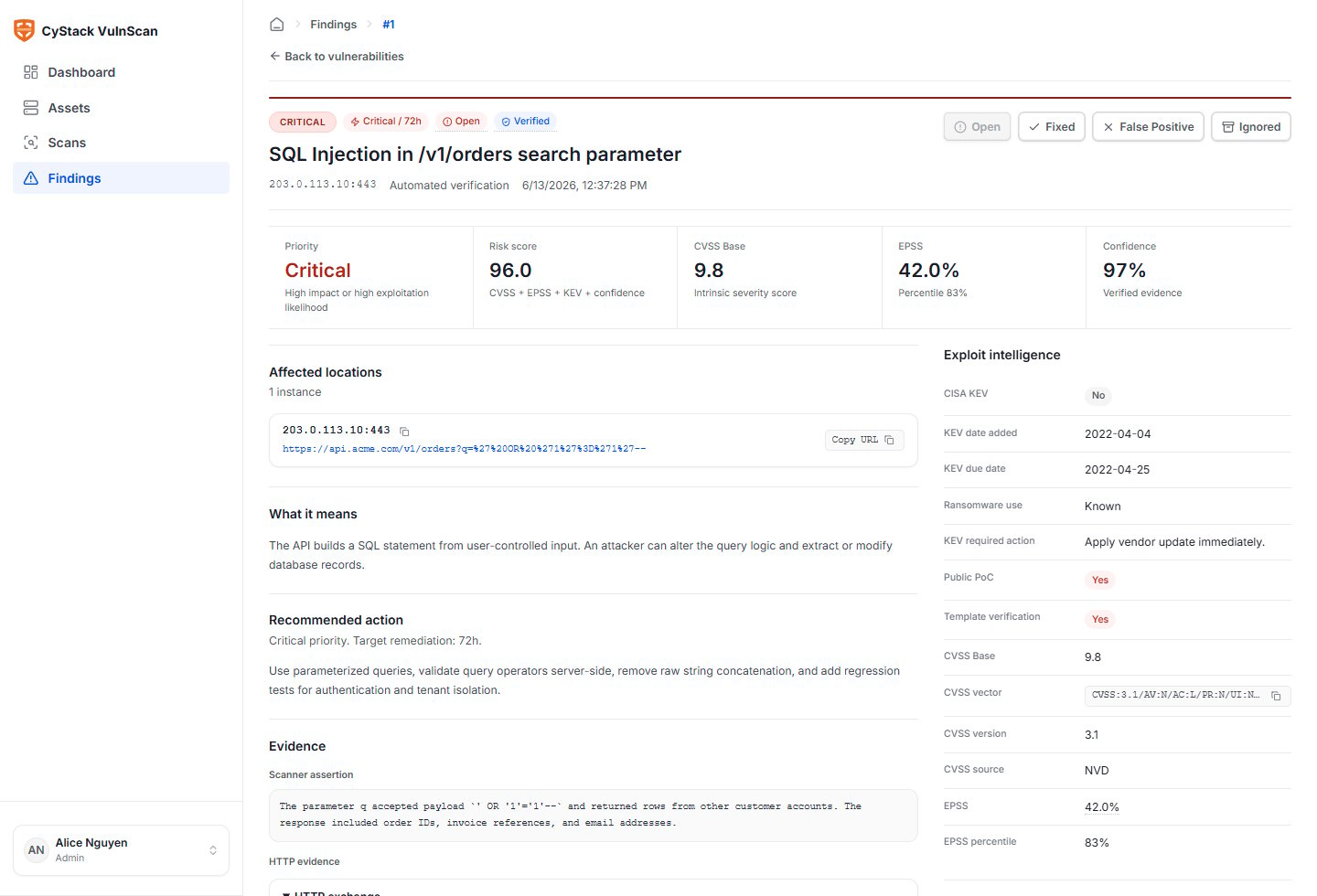
Finding Fields
Severity and Risk Score
Severity is a categorical view of technical impact. Risk score is a prioritization signal. A High finding can receive a higher risk score when it has strong exploitability signals, public exploitation, high confidence, or verified evidence. A Critical finding can receive a lower risk score when confidence is limited or the affected component is not externally exploitable in the observed context. VulnScan uses the following signals when calculating risk:- CVSS base score where available.
- EPSS probability where available.
- CISA KEV presence.
- Public exploit or proof-of-concept indicators.
- Detection confidence.
- Whether the issue was actively verified.
- Asset and service context collected during discovery.
Evidence Types
Evidence depends on the vulnerability class:- HTTP request and response behavior.
- Reflected or stored payload confirmation.
- Service banner and protocol response.
- Product and version evidence.
- Exact or range version match against CPE/CVE intelligence.
- TLS certificate and protocol details.
- Exposed file, directory, panel, endpoint, or metadata.
- Cloud storage or subdomain takeover indicators.
- Authentication or authorization behavior.
Triage Workflow
Use a consistent status workflow:- Review Critical and High findings first.
- Confirm the affected asset and owner.
- Read evidence and remediation.
- Create an internal remediation ticket.
- Mark the finding as in progress if your workflow tracks ownership.
- Re-scan after the owner reports a fix.
- Close the finding only after scan evidence confirms remediation.
- Mark as accepted risk or false positive only with reviewer notes.
Standards Mapping
VulnScan maps findings to security standards so teams can connect technical issues to audit and remediation programs:- OWASP Top 10 2021: all ten categories are covered by mapping from detectors, CWE, and vulnerability classes.
- OWASP WSTG: 70+ testing-guide mappings help analysts understand how the issue would be tested manually.
- CWE: 196 CWE mappings connect findings to standardized weakness categories.
- CVE: known vulnerable components are mapped through local vulnerability intelligence.
Common Finding Categories
VulnScan focuses on high-impact externally reachable risks, including:- Injection: SQL, command, code, NoSQL, template, and client-side template injection.
- Cross-site scripting: reflected, stored, and DOM-based XSS.
- Access control and authentication weaknesses.
- SSRF, open redirect, CSRF, and insecure file upload.
- LFI/RFI, path traversal, and sensitive file exposure.
- HTTP request smuggling and cache poisoning.
- Insecure headers, CORS, CSP, and clickjacking.
- Exposed admin panels, debug endpoints, Swagger/OpenAPI, GraphQL, and actuator endpoints.
- Cloud storage exposure and subdomain takeover.
- Weak TLS, expired certificates, and unsafe protocol support.
- Default credentials and unauthenticated network services.
- Known CVEs in web, network, CMS, plugin, framework, and server components.
Reducing False Positives
False-positive reduction is built into multiple stages:- Version matches prefer exact or bounded version ranges.
- Generic CPE matches are suppressed when they do not prove product/version exposure.
- Duplicate findings are merged by vulnerability, host, port, and title.
- Verified evidence is preferred over weaker duplicate evidence.
- Confidence is shown so analysts can decide what needs manual review.
- Re-scans can confirm whether a fix actually changed observed behavior.