> ## Documentation Index
> Fetch the complete documentation index at: https://docs.cystack.net/llms.txt
> Use this file to discover all available pages before exploring further.
# Overview
> CyStack VulnScan product positioning, value, and operating model
**CyStack VulnScan** is an enterprise vulnerability scanning product developed and owned by CyStack. It helps organizations continuously understand their external attack surface, detect exploitable vulnerabilities, prioritize what to fix first, and produce evidence-backed reports for security, IT, engineering, compliance, and executive stakeholders.
CyStack VulnScan has been granted Copyright Registration Certificate No. **10694/2025/QTG** by the Copyright Office of Vietnam under the Ministry of Culture, Sports and Tourism of Vietnam.
 ## Why Organizations Use VulnScan
Modern attack surfaces change every day: new subdomains, exposed admin panels, temporary APIs, outdated services, forgotten cloud buckets, weak TLS, and vulnerable third-party components. A one-time penetration test cannot provide continuous visibility, while raw scanner output is often too noisy for remediation teams.
CyStack VulnScan is designed to close that gap:
* **Find more real risk** by combining discovery, service fingerprinting, active vulnerability checks, version-to-CVE matching, vulnerability intelligence, and optional AI-assisted analysis.
* **Reduce false positives** by requiring concrete version evidence, exact/range CPE matching, verification signals, confidence scoring, deduplication, and optional AI review of noisy evidence.
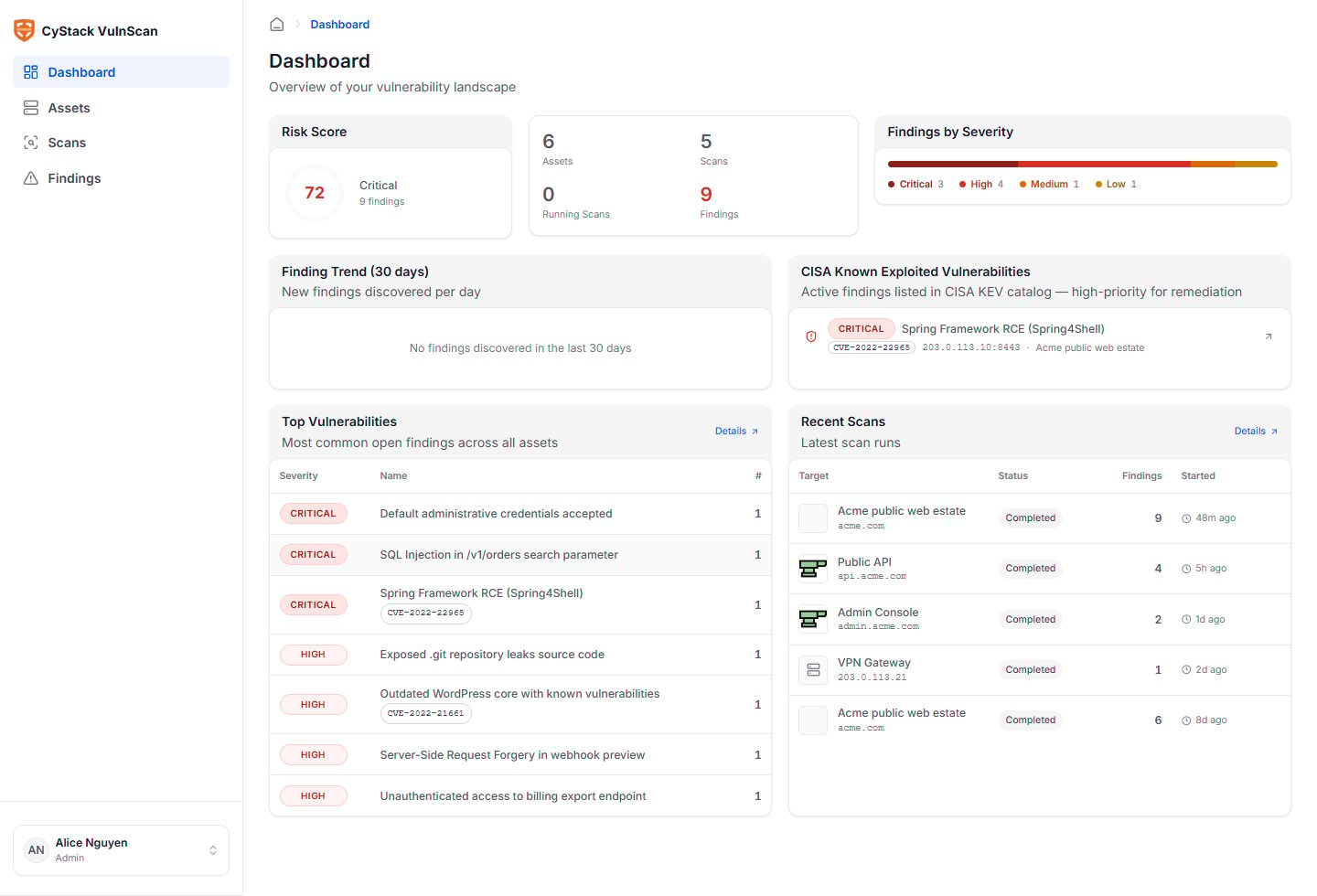
* **Prioritize remediation** with severity, CVSS, EPSS, CISA KEV, public exploit indicators, confidence, and a 0-100 risk score.
* **Support both Web UI and CLI** so analysts can work interactively while automation pipelines still write scan history into the same database.
* **Produce management-ready output** through bilingual UI/reporting, PDF jobs, CSV/JSON export, and email notification.
* **Support governed usage** through visible license scope, target limits, activation status, and expiration information.
## What VulnScan Can Assess
VulnScan is focused on Internet-facing assets and externally reachable services:
| Scope | Examples | What VulnScan Checks |
| ---------------------- | -------------------------------------- | -------------------------------------------------------------------------------------------------- |
| Domains | `acme.com` | DNS, subdomains, web exposure, WAF/CDN, TLS, web vulnerabilities, exposed files, misconfiguration. |
| Subdomains | `api.acme.com` | Application/API risk, endpoint discovery, known CVEs, authentication-sensitive checks. |
| IP addresses | `203.0.113.21` | Open ports, service banners, protocol checks, weak/default access, TLS and service CVEs. |
| CIDR/ranges | `203.0.113.0/28` | Live host discovery, exposed services, inherited license target counting, scan history per host. |
| Authenticated web apps | Cookie, header, Basic Auth, form login | Deeper crawling and checks behind login where credentials are provided by the user. |
## Product Capabilities at a Glance
| Area | Capability |
| ----------------------- | ------------------------------------------------------------------------------------------------------------------------------------------------------------------------------------------------------------------------------------- |
| Discovery | DNS/subdomain discovery, live host probing, port scanning, service detection, technology fingerprinting, WAF/CDN detection, TLS inspection. |
| Vulnerability detection | Built-in DAST modules, high-confidence CyStack checks, known-CVE detection, weak/default credential checks, unauthenticated service checks, HTTP misconfiguration checks, and optional AI-assisted evidence analysis. |
| Active protection (WAF) | Edge-layer Web Application Firewall on self-operated edge nodes: managed OWASP ruleset, custom rules, AI virtual patches, rate limiting, IP/country/ASN access control, and traffic monitoring. See [WAF](/en/vulnscan/waf-overview). |
| Intelligence | Local NVD CPE-to-CVE database, CVSS, EPSS, CISA KEV, CWE, OWASP Top 10, OWASP WSTG, public exploit indicators. |
| Accuracy controls | Exact/range version matching, confidence scoring, verified finding preference, deduplication, wildcard-CPE suppression, source normalization. |
| Workflow | Web UI, CLI, schedules, workspace members, scan source tracking, report jobs, email notifications. |
| AI and localization | Optional AI-assisted detection support, false-positive reduction, prioritization, remediation explanation, executive summaries, and English/Vietnamese output where enabled. |
## How a Scan Works
1. **Scope and license validation**: VulnScan normalizes the target and validates it against the active license before work is queued.
2. **Discovery**: The scanner discovers alive hosts, subdomains, open ports, server metadata, WAF/CDN signals, TLS certificates, and web/API endpoints.
3. **Fingerprinting**: Services, technologies, CMS/frameworks, WordPress plugins/themes, protocol banners, TLS details, SSH/SMB/SNMP hints, and CPE candidates are identified.
4. **Detection**: Built-in DAST checks, CyStack verification checks, unauthenticated-service checks, default-credential checks, optional AI-assisted analysis, and CPE-to-CVE matching run against the discovered surface.
5. **Enrichment**: Findings are enriched with CVSS, EPSS, CISA KEV, CWE, OWASP Top 10, OWASP WSTG, remediation guidance, and exploitability signals.
6. **Deduplication and scoring**: Duplicate findings are merged, the highest-confidence evidence is kept, and a risk score is calculated.
7. **Persistence**: Standard Web UI, scheduled, and CLI scans are written to the same database with scan source metadata.
8. **Reporting**: Users triage findings in the Web UI or export CSV, JSON, and PDF reports.
## Scan to find, WAF to protect
VulnScan combines two complementary capabilities in the same workspace:
* **Vulnerability scanning** helps you *find* risk: asset discovery, technology fingerprinting, active checks, CVE matching, and prioritization.
* **CyStack WAF** helps you *actively prevent* exploitation at the edge: point your domains through self-operated edge nodes, enable the managed OWASP ruleset, and add custom rules.
The two are directly linked: a web vulnerability that a scan has just discovered can be **virtually patched** at the WAF while your development team fixes it in the source code, narrowing the window of risk. See [WAF overview](/en/vulnscan/waf-overview).
The word "WAF" is used in two senses in this documentation: **WAF/CDN detection** is the scan recognizing whether a target organization uses a WAF/CDN (for example Cloudflare); **CyStack WAF** is the firewall product your own organization deploys to protect its sites.
## Deployment Model
CyStack VulnScan is distributed as a binary application compatible with **Windows**, **macOS**, and **Linux**. To obtain the binary and a matching license, contact CyStack Sales at [sales@cystack.net](mailto:sales@cystack.net).
One binary supports two operating modes:
* **Web UI** for interactive asset management, scanning, triage, reports, members, mail settings, and license management.
* **CLI** for automation, scheduled jobs, CI/security pipelines, offline preparation, and scripted report export.
Each instance is treated as one workspace. Workspace data is stored locally in the configured data directory, including members, assets, scans, findings, reports, mail settings, and license state.
## Why Organizations Use VulnScan
Modern attack surfaces change every day: new subdomains, exposed admin panels, temporary APIs, outdated services, forgotten cloud buckets, weak TLS, and vulnerable third-party components. A one-time penetration test cannot provide continuous visibility, while raw scanner output is often too noisy for remediation teams.
CyStack VulnScan is designed to close that gap:
* **Find more real risk** by combining discovery, service fingerprinting, active vulnerability checks, version-to-CVE matching, vulnerability intelligence, and optional AI-assisted analysis.
* **Reduce false positives** by requiring concrete version evidence, exact/range CPE matching, verification signals, confidence scoring, deduplication, and optional AI review of noisy evidence.
* **Prioritize remediation** with severity, CVSS, EPSS, CISA KEV, public exploit indicators, confidence, and a 0-100 risk score.
* **Support both Web UI and CLI** so analysts can work interactively while automation pipelines still write scan history into the same database.
* **Produce management-ready output** through bilingual UI/reporting, PDF jobs, CSV/JSON export, and email notification.
* **Support governed usage** through visible license scope, target limits, activation status, and expiration information.
## What VulnScan Can Assess
VulnScan is focused on Internet-facing assets and externally reachable services:
| Scope | Examples | What VulnScan Checks |
| ---------------------- | -------------------------------------- | -------------------------------------------------------------------------------------------------- |
| Domains | `acme.com` | DNS, subdomains, web exposure, WAF/CDN, TLS, web vulnerabilities, exposed files, misconfiguration. |
| Subdomains | `api.acme.com` | Application/API risk, endpoint discovery, known CVEs, authentication-sensitive checks. |
| IP addresses | `203.0.113.21` | Open ports, service banners, protocol checks, weak/default access, TLS and service CVEs. |
| CIDR/ranges | `203.0.113.0/28` | Live host discovery, exposed services, inherited license target counting, scan history per host. |
| Authenticated web apps | Cookie, header, Basic Auth, form login | Deeper crawling and checks behind login where credentials are provided by the user. |
## Product Capabilities at a Glance
| Area | Capability |
| ----------------------- | ------------------------------------------------------------------------------------------------------------------------------------------------------------------------------------------------------------------------------------- |
| Discovery | DNS/subdomain discovery, live host probing, port scanning, service detection, technology fingerprinting, WAF/CDN detection, TLS inspection. |
| Vulnerability detection | Built-in DAST modules, high-confidence CyStack checks, known-CVE detection, weak/default credential checks, unauthenticated service checks, HTTP misconfiguration checks, and optional AI-assisted evidence analysis. |
| Active protection (WAF) | Edge-layer Web Application Firewall on self-operated edge nodes: managed OWASP ruleset, custom rules, AI virtual patches, rate limiting, IP/country/ASN access control, and traffic monitoring. See [WAF](/en/vulnscan/waf-overview). |
| Intelligence | Local NVD CPE-to-CVE database, CVSS, EPSS, CISA KEV, CWE, OWASP Top 10, OWASP WSTG, public exploit indicators. |
| Accuracy controls | Exact/range version matching, confidence scoring, verified finding preference, deduplication, wildcard-CPE suppression, source normalization. |
| Workflow | Web UI, CLI, schedules, workspace members, scan source tracking, report jobs, email notifications. |
| AI and localization | Optional AI-assisted detection support, false-positive reduction, prioritization, remediation explanation, executive summaries, and English/Vietnamese output where enabled. |
## How a Scan Works
1. **Scope and license validation**: VulnScan normalizes the target and validates it against the active license before work is queued.
2. **Discovery**: The scanner discovers alive hosts, subdomains, open ports, server metadata, WAF/CDN signals, TLS certificates, and web/API endpoints.
3. **Fingerprinting**: Services, technologies, CMS/frameworks, WordPress plugins/themes, protocol banners, TLS details, SSH/SMB/SNMP hints, and CPE candidates are identified.
4. **Detection**: Built-in DAST checks, CyStack verification checks, unauthenticated-service checks, default-credential checks, optional AI-assisted analysis, and CPE-to-CVE matching run against the discovered surface.
5. **Enrichment**: Findings are enriched with CVSS, EPSS, CISA KEV, CWE, OWASP Top 10, OWASP WSTG, remediation guidance, and exploitability signals.
6. **Deduplication and scoring**: Duplicate findings are merged, the highest-confidence evidence is kept, and a risk score is calculated.
7. **Persistence**: Standard Web UI, scheduled, and CLI scans are written to the same database with scan source metadata.
8. **Reporting**: Users triage findings in the Web UI or export CSV, JSON, and PDF reports.
## Scan to find, WAF to protect
VulnScan combines two complementary capabilities in the same workspace:
* **Vulnerability scanning** helps you *find* risk: asset discovery, technology fingerprinting, active checks, CVE matching, and prioritization.
* **CyStack WAF** helps you *actively prevent* exploitation at the edge: point your domains through self-operated edge nodes, enable the managed OWASP ruleset, and add custom rules.
The two are directly linked: a web vulnerability that a scan has just discovered can be **virtually patched** at the WAF while your development team fixes it in the source code, narrowing the window of risk. See [WAF overview](/en/vulnscan/waf-overview).
The word "WAF" is used in two senses in this documentation: **WAF/CDN detection** is the scan recognizing whether a target organization uses a WAF/CDN (for example Cloudflare); **CyStack WAF** is the firewall product your own organization deploys to protect its sites.
## Deployment Model
CyStack VulnScan is distributed as a binary application compatible with **Windows**, **macOS**, and **Linux**. To obtain the binary and a matching license, contact CyStack Sales at [sales@cystack.net](mailto:sales@cystack.net).
One binary supports two operating modes:
* **Web UI** for interactive asset management, scanning, triage, reports, members, mail settings, and license management.
* **CLI** for automation, scheduled jobs, CI/security pipelines, offline preparation, and scripted report export.
Each instance is treated as one workspace. Workspace data is stored locally in the configured data directory, including members, assets, scans, findings, reports, mail settings, and license state.